Posts

One of us

Image
Christmas has not always been celebrated by the Church. For the first few centuries, the most important holy day was Easter. The crucifixion and resurrection of Jesus Christ were the central events of salvation. The birth of Jesus was of little concern. Perhaps this is because only two of the Gospels even make mention of it. John and Mark take Jesus’ existence for granted. No need to talk about someone’s birth when it is self-evident that they must have been born. Of course, to some in the early Christian movement, it was not self-evident that Jesus was born. For some who believed that Jesus only appeared to be human, Jesus’ physical birth was a non-issue because it never happened. For some who believed that Jesus became the Son of God only when he was adopted by God at his baptism, his physical birth was like everyone else’s. No big story there. It isn’t until around the second century that we find records of any celebration of the birth of Jesus, and these assign it to Janua...

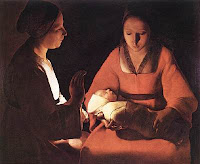
What does this story have to do with Christmas?

Image
So here's a question to ponder: is Christmas all about happy feelings, joy and good will and peace and sugary sentiments? If you answered "yes," (and who doesn't hope for such things in life?), then read this part of the Christmas story: Matthew 2:13-23. Leonard Sweet has this to say about all this: This is the time of year when we need to be on high alert for cute. We love cuteness. This is a cute-driven culture. And this season of year turns everything it touches into glitz and cuteness. But the story of Jesus’ birth wasn’t cute. The Annunciation wasn’t cute. The virgin birth wasn’t cute. The Magnificat wasn’t cute. The little town of Bethlehem wasn’t cute. The killing of the innocents wasn’t cute. The nativity genealogy puts Mary in the lineage of Tamar, Rahab, Bathsheeba, and Ruth (yes, the one who snuck in to the rich Boaz’s tent at night while he was sleeping to seduce him). Jesus’ genealogy is not cute. Golgatha wasn’t cute. “Crux” in Latin me...
Image
This next Sunday the choir at our church will be presenting a Cantata, "Go Tell It!" There will be one service at 10:00, so there will not be a sermon. So what follows are some interesting links to sites concerning the origins of Advent,Christmas and Epiphany. Obviously - or it should be obvious to anyone with a healthy sense of historical development and change - Christmas has not always been celebrated as we do now. Like most festivals and holidays, it has undergone a variety of changes  and it has an interesting evolutionary history. The Catholic Encyclopedia Online has an in-depth and rather scholarly look at the origins and early testimonies to the dating and celebration of Christ's birth.  Highlights: Possible connections with the roman festival of Sol Invictus (the Victorious Sun), various pagan accretions as Christianity spread throughout Europe and Asia, earliest mention of anything celebrating the birth of Jesus dates to about the year 200 C.E. Any website...

What an Imagination!

Image
I love watching science fiction shows. Not the horror kind, but the kind that depict possible futures, exploring space, time travel and the like. Science fiction functions as a vehicle for people to think about alternative ways of living or ways to address current social problems. Some of my favorites have been TV series such as Star Trek (all the various series), Star Wars, Firefly, The Time Tunnel, Lost in Space, Aeon Flux, Solaris, among others. What especially appeals to me is how these shows imagine and then depict a different world from that which I experience everyday. Occasionally the things imagined come true in “real” life. Think of the communicators from Star Trek. They look and act just like today’s cell phones. I’m still waiting for the convenience of transporters to be able to teleport to work, rather than just telecommute via computers. The ancient prophets had a similar imagination. They imagined a world different from the one they knew at the present – their pres...

Cleaning Up Our Act

Image
Here we are in Advent.  Waiting. Waiting. Getting ready. Getting prepared. Decorating the house maybe. Prettying things up, dusting off the ornaments, maybe. Thinking about Christmas gift shopping, maybe. Getting ready. But for what? The same old holiday as before? The same old Christmas tunes endlessly blaring at us when we're shopping? The same pressures each year at this time? Maybe it's time for a change, time to stop, really feel the chill in the air, really sense the darkness gathering and lapping at our feet like a rising tide. Time to allow ourselves to feel the unrest inside, acknowledge the cobwebs in the corners, the dirt behind our ears. Time to look at the tarnished silver in our drawers and tarnished gold in our hearts. The prophet Malachi is just the person for such a time. In chapter 3:1-4 , he talks about one who will come to help us clean up our act. Or should I say "acts?" For this one will come to help us individually and collectivel...

Of Wars and Plagues and Praise

Image
It was the middle of the Thirty Years War and the people in the German province of Saxony had felt the brunt of invasions, quartering soldiers in their homes, having their lands and crops and animals seized. Martin Rinkart was a pastor serving the church in Eilenb urg at the time, and carried his church through the whole war. In the midst of the war, a severe plague broke out in Northern Europe in 1637, and hit Eilenburg especially hard. 8000 persons died in this year alone, and Rinkart buried some 4500 that year, including his own wife.  There was something about Rinkart's deep faith that carried him through this time. Other clergymen fled the town for safer locations, and some succumbed to the plague. But in it all, Rinkart carried on, and persevered to write one of the most beloved of hymns in the German language, "Nun danket alle Gott." It is translated in English as "Now thank we all our God." I used to think this hymn was another one of those insipid h...

Taking Grace for Granted

This Sunday is the Sunday before Thanksgiving. Therefore it is an appropriate time to reflect upon the act of giving thanks, of expressing our gratitude. This year for Thanksgiving I will gather with my family at my parent's home. Most of my brothers will be there with their families. One of my brothers will be there without someone very dear to him: his wife who died two years ago. Whenever we have gathered, we always took for granted that everyone would be there. The kids would be a little older, and there would always be the latest exploits of our children to share. But the death of my sister-in-law came way too soon, at way-too-young an age. So when I look around the family, I don't take it quite for granted anymore. The blessings that are there are not necessarily a given.  How many things in our life do we take for granted? How many things do we fail to give thanks for? How many times do we receive a gift and forget to express our gratitude? I know that I have do...